The Lamb in the Classroom: Gonerby YFC's Farm to School Gamble Is Working
Photo: Geoff Charles, CC BY-SA 4.0, via Wikimedia Commons
Year 4 at a Grantham primary school have been told a lamb is coming. They have not been told it will poo on the carpet. The teacher has. This is the sort of risk assessment Gonerby YFC's Farm to School team now does for a living.
The programme launched in September 2026. It began with a simple question: how many children in the village could tell you where a pint of milk comes from? The answer, in a straw poll of two classes, was fewer than half. Most could describe a supermarket aisle. Very few could describe a farm gate.
So the club decided to bring the farm gate to them.
The launch
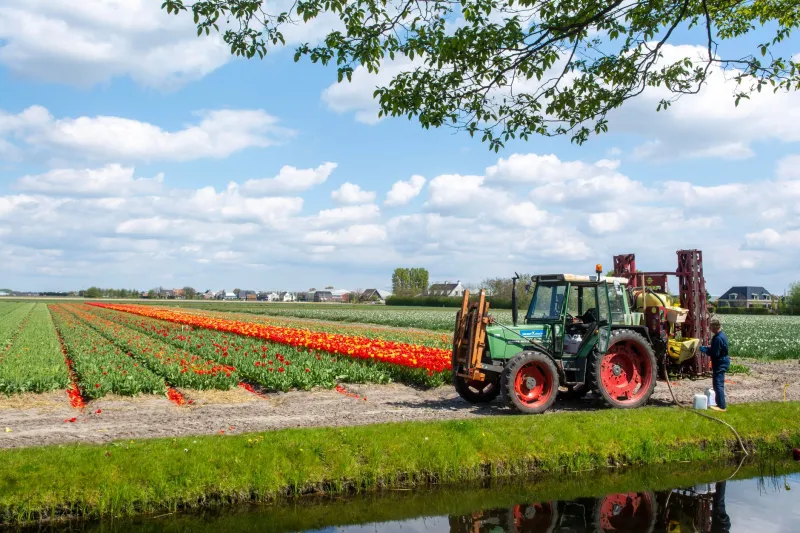
Farm to School is not a petting zoo. That is the first thing the team wants to make clear. It is a structured visit, usually two hours, built around three stations: soil, animals and machinery. Children get their hands in soil samples, compare different types of grain, meet a lamb or a calf, and sit in a tractor cab. They also get a short talk on what farmers do in winter, which is often the bit that surprises them most.
'They think farmers only work when it's sunny,' says organiser Bethany Cawston. 'We show them the lambing photos. We show them the frost. We show them the paperwork. They're genuinely shocked.'
The first visit took place at a village primary in late September. The team brought two lambs, a selection of soil samples, a grain display and a tractor that took three attempts to get through the school gate. The children were briefed on hand-washing before they went anywhere near the animals. The lambs were briefed on nothing and behaved accordingly.
Small hands, big questions
The questions come thick and fast. Why does the lamb shake? How much does a tractor cost? Do farmers go on holiday? Is soil alive? Why is the sky blue? (That one is not on the curriculum, but it gets answered anyway.)
'You can see the moment it clicks,' says Cawston. 'A child holds a handful of soil and you say, 'This is where your chips come from.' They look at you like you've told them the moon is made of cheese. Then they ask another question. That's the whole point.'
The team has now visited four schools, with three more booked before Christmas. The visits are funded by the club, with support from a local agricultural supplier and a small grant from the county YFC. There is no charge to schools. That was a deliberate decision.
'We didn't want it to be a treat for schools that already had a big budget,' says club chair Will Naylor. 'Every school should be able to say yes.'
The gap
The programme is a response to a gap that has been widening for years. Children in rural Lincolnshire can live within two miles of a farm and still have almost no direct experience of food production. They see fields from a car window. They see meat in plastic trays. The bit in between is often invisible.
'It's not that parents are doing anything wrong,' says Cawston. 'It's just that life is busy. Farms are businesses. You can't just walk into a yard and ask to see a lamb. Health and safety, insurance, biosecurity. It's not like it was thirty years ago.'
Farm to School is an attempt to bridge that gap carefully. The team follows biosecurity rules, carries its own hand-washing equipment and works with teachers on risk assessments. It is not a free-for-all. It is a structured visit with a clear message: food comes from somewhere, and that somewhere is worth understanding.
What the children take home
The feedback from teachers has been positive. One Year 4 teacher said the visit had 'done more for their understanding of food chains than three worksheets.' Another said the children had talked about it for a week. A third asked whether the team could come back in the spring to see the lambs grow.
The children's feedback is less formal. 'The lamb was soft.' 'The tractor was massive.' 'I didn't know potatoes grew in mud.' 'I want to be a farmer now, but only if I can drive the big one.'
That last comment gets a laugh from the team. But it also points to something bigger. The programme is not trying to turn every child into a farmer. It is trying to make sure that when they are adults, they understand what farming involves. That matters for policy, for shopping, for planning meetings and for the next generation of rural businesses.
The next field
The club is already planning the 2027 programme. There are talks with a secondary school about a more detailed visit for GCSE geography students. There is an idea for a 'farm to fork' day where children make butter and bread. There is even a plan for a virtual tour for schools that cannot accommodate a tractor.
For now, though, the focus is on the basics: lambs, soil, tractors and questions. The team has learned to expect the unexpected. A lamb will escape. A child will ask something brilliant. A teacher will ask whether the team can come back next term. And someone will always, always ask if the tractor has a cup holder.
'It's the best thing we do,' says Cawston. 'You can talk about bridging the gap all you like. But you only really bridge it when a child puts their hand in the soil and looks at you like you've just opened a door.'